Royal

Menus

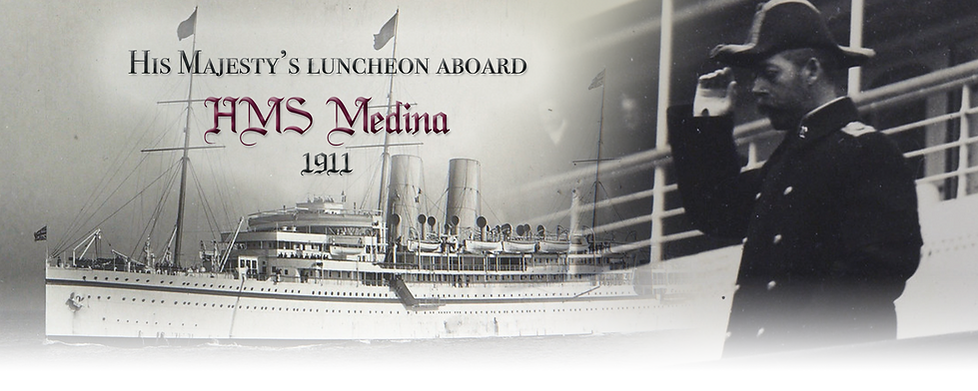
King George V and Queen Mary had just boarded the HMS Medina for their 12,000 kilometre voyage to the Delhi Durbar where they would be crowned Emperor and Empress of India.
The royal couple had left Buckingham Palace at 10am and travelled to Portsmouth by Royal Train from Victoria Station. Once aboard the ship, they hosted this farewell lunch before setting sail. The young Prince of Wales, and future Edward VIII, bemoaned in his memoirs:
“On November 11 my father and mother sailed for ‘India’ with a large suite in H.M.S. Medina. I went to Portsmouth to see them off, and this was another disappointment, for I had hoped they would take me with them to be a witness of the Oriental splendour of the Coronation Durbar at Delhi. But my father prescribed that I should stay at home to work up the new subjects I would have to take at Oxford”.
With his parents gone, however, the Prince remembered that he soon “enjoyed this period of freedom from parental restraint”.
Attached to His Majesty’s suite was the official historian, Hon. John Fortescue, who recounted that:
“His Majesty's guests at luncheon, including the suite that was accompanying him to India, numbered in all fifty-three. At a little after half-past two these guests took leave of Their Majesties and returned to the shore, Queen Mary supporting Queen Alexandra [the King’s mother] to the gangway”.
Also attending this lunch was the King’s sister, Queen Maud of Norway; and a young future Prime Minister Rt. Hon. Winston Spencer-Churchill MP and his wife, Clementine. Just one month earlier, Churchill had been appointed First Lord of the Admiralty.
The Consommé à l'Indienne was a curried chicken consommé garnished with cubes of diced royale made from coconut milk; and served with a small dish of semi-dried steamed rice on the side.
At a stretch the flavours of the Pilaff de Cailles – quails casseroled in butter and served on a bed of pilaf rice - may have had an Indian influence. It was, after all, always a mighty challenge for royal chefs to ascribe French culinary terms to oriental dishes. But its name “Pilaff” on the menu sounds distinctly Persian.
For dessert came rum-babas swimming in syrup and piped full of custard with chopped crystallised fruits; with baked pears on the side.
At 2:50pm the cannons boomed their Royal Salute and the Medina slipped off the wharf. Eleven dreadnoughts accompanied the royal ship out to sea with its convoy of four cruisers that would escort the Medina all the way to India.
The newly built Medina, painted white and trimmed in a line of blue and gold, had been especially fitted as the King and Queens’ floating palace for the journey that would take them past Gibraltar, through the Suez Canal and on to India. When it returned in the New Year, it became part of the P&O stable of steamships and took on the service to Australia.
For the voyage to India with its royal passengers aboard, the ship had to officially take on the initials HMS for His Majesty's Ship; and the menu-cards carrying the dual monogram of the King and Queen.
For the journey, George V was official styled “King-Emperor”. Although he had visited India as a young prince, this was the first time a British monarch had attended their Coronation as Imperial ruler of India: a position that started in 1877 when Queen Victoria became its Empress.
P
erhaps the royal chefs were being comical and thought His Majesty’s taste buds needed to acquaint themselves better with the spicy flavours of India when the Consommé à l'Indienne was ladled out.

Royal Menu Collection / © Jake Smith
Menu
Consommé à l'Indienne: Curried chicken consommé garnished with cubes of diced royale made from coconut milk; semi-dried steam rice on the side | Oeufs Meyerbeer: Baked potted eggs topped with grilled lamb's kidney and surrounded with Périgueux sauce made from braised truffles in Madeira (named after German composer, Giacomo Meyerbeer) | Côtelettes d'agneau à la Maréchale: Sautéed crumbed lamb cutlets topped with braised truffles and asparagus tips and dressed in maître d'hotel butter made from lemon juice and parsley | Pilaff de Cailles: Quails casseroled in butter and served atop a pilaf rice (pilau) and dressed with a tomatoe and onion sauce mixed with the casserole juices | Viandes froides: Cold meats | Salade: Salad | Savarin à la Pompadour: Cakes made from baba dough that have been soaked in rum and filled with custard mixed with chopped crystalised fruits | Poires à la Saxe: Pear halves baked in butter and brown sugar.
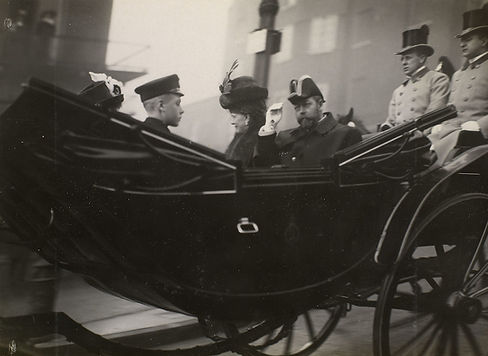
"Our departure from London for India", wrote Queen Mary beneath this photo in her private album dated 11 November 1911. (L-R) The Prince of Wales (future Edward VIII), Queen Mary and King George V.
(Photo: Royal Collection Trust / © His Majesty King Charles III, 2026)

The King (left) on the deck of HMS Medina as it passes by Malta.
(Photo: Royal Collection Trust / © His Majesty King Charles III, 2026)


En route to India, HMS Medina stops at Port Said, Egypt, on 21 November 1911. King George V welcomes aboard the Khedive of Egypt, Abbas II, while the Grand Vizier of the Ottoman Empire, Pasha Kâmel, kisses the hand of Queen Mary.
(Photo: Royal Collection Trust /
© His Majesty King Charles III, 2026)
In the news...
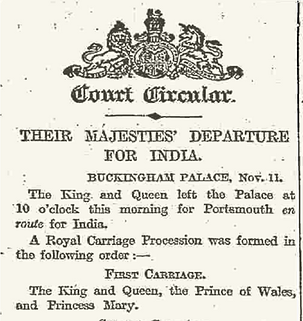
The Times, November 1911
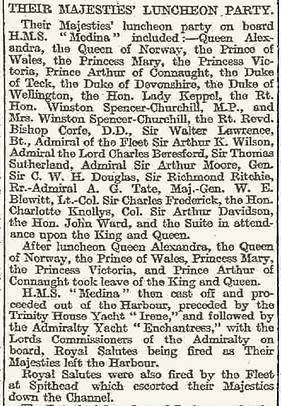
The Times, November 1911
1911

New York Times, 12 November 1911

HMS Serapis moored in Calcutta during
the visit of the Prince of Wales, 1875-76.
(Photo: Royal Collection Trust / © His Majesty King Charles III, 2026)